
Have you ever scrubbed windows until your arms felt sore, only to step back and see streaks or spots? The culprit is often minerals in tap water. Deionized (DI) water, which has had all mineral ions removed, solves this problem by drying completely clear. In this guide, we’ll explain what DI water is, why it’s perfect for spotless windows, and exactly how you can make it at home or on the job. Whether you’re a homeowner or window-cleaning enthusiast, these steps and tips will help you achieve crystal-clear, streak-free glass every time.
What is deionized water and why is it ideal for window cleaning?
Deionized water is simply pure water with its minerals and charged particles removed. In practice, that means no hard water stains or streaks. Professional cleaners use DI water for a spotless finish, since it dries completely clear on glass. In practice, that means no hard water stains or streaks. Professional cleaners use DI water for a spotless finish, since it dries completely clear on glass.
Benefits of DI water for windows
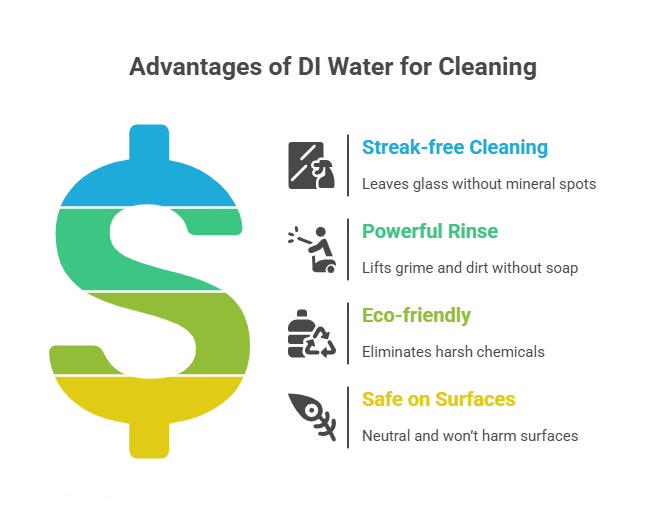
- Streak-free cleaning: Unlike tap water, DI water will leave glass sparkling with no mineral spots.
- Powerful rinse: Its high purity helps lift grime and dirt without extra soap.
- Eco-friendly: It eliminates the need for harsh chemicals, making cleaning safer for you and the planet.
- Safe on surfaces: DI water is neutral and won’t harm window frames, seals, or nearby plants. It’s even recommended for delicate lab and electronics cleaning because it’s so pure.
What equipment do I need to make deionized water for cleaning windows?
Creating DI water at home can be simple or advanced, depending on your needs. At minimum, you will need a deionization filter or cartridge and a way to move water through it. Here’s what’s typically required:
- DI Filter/Cartridge: This is a container filled with mixed ion-exchange resin (both cation and anion resins). You can buy compact inline cartridges or larger resin tanks designed to hook up to a hose. They are often sold for window cleaning or aquarium use.
- Water Source Adapter: A garden-hose fitting or faucet adapter to feed tap water into your filter. Many DI cartridges simply screw onto a standard hose spigot.
- Reverse Osmosis (RO) System (optional): For very hard water or high-purity needs, an RO system serves as an extra stage. RO membranes remove most impurities first, then DI resin polishes the water.
- Collection Container: A clean bucket or tank to catch the purified water. Sealable containers keep the DI water from re-picking up dust or minerals.
- TDS Meter: A small digital meter that measures total dissolved solids in ppm. It’s invaluable for checking if your water is truly pure (ideally below 10 ppm for windows).
With these tools, you’re ready to set up a DI system. Many hardware stores and online retailers sell complete portable DI kits that fit onto a hose for easy home use.
How does deionization filtration work to purify water?
The magic of DI water lies in ion exchange resins. Imagine hundreds of porous plastic beads, each coated with charged sites. As tap water flows through a DI filter, these beads swap unwanted ions for hydrogen or hydroxide ions. For example, a resin bead may pull calcium (Ca²⁺) out of the water and release two hydrogen ions (H⁺) in exchange. Meanwhile an anion resin might capture chloride (Cl⁻) and release OH⁻. The released H⁺ and OH⁻ quickly combine to form fresh H₂O. Over the length of the filter, virtually all mineral ions are caught.
- Mixed-bed resin: Most DI filters use a mix of cation and anion resins in one cartridge. This ensures both positive and negative ions are removed at once.
- Result: The output is ultrapure water. Top-quality mixed-bed resin can reduce the TDS (total dissolved solids) reading to near zero, meaning almost no minerals remain.
In short, DI filtration replaces every “dissolved solid” in your tap water with harmless H or OH, yielding virtually mineral-free water.
How do I set up a DIY deionization filter at home?
You don’t need a lab to make DI water. Many window cleaners start with a simple resin canister or cartridge on a hose. Here’s one way to DIY it:
- Prepare the DI vessel: Buy mixed-bed DI resin (often sold for aquarium or cleaning use) and fill a clean plastic or glass container designed for filtration. Some people use a 5-gallon bucket fitted with a spigot, or a purpose-made cartridge housing.
- Attach to water: Connect your hose or pump so water flows into the top of the resin-filled chamber. If using a ready-made cartridge, simply screw it onto the hose as per manufacturer instructions.
- Flush the system: Run cold water through slowly for a few minutes. This ensures any loose resin dust or air bubbles are cleared out. Collect and discard the first batch if it’s cloudy.
- Collect DI water: Turn on the water and let it pass through the resin. The outflow (from a faucet, spigot, or bottom port) is now deionized. Fill your clean bucket or spray tank with this water.
- Double-check purity: Optionally, run the water through the filter a second time or use a TDS meter to confirm purity. If the meter reads above ~10 ppm, run it through again.
Quick Equipment Setup
- Inline DI Cartridge: Screw onto hose, run water through, collect output.
- Resin Tank: Fill tank with resin, connect hose, run water through.
- Storage: Always use a clean, airtight container for DI water storage.
This DIY approach gives you spot-free water using only readily available parts. For larger jobs or very hard water, consider a combined RO/DI cart.
Can I use a reverse osmosis (RO) system to produce deionized water?
Yes, a reverse osmosis unit is a great first step. An RO system forces water through a semipermeable membrane, removing up to 95–99% of dissolved salts. The partially purified water can then be polished by a DI filter. In practice, many setups use RO and DI in sequence:
- Connect the RO: Hook up the RO unit to your water tap (often via a hose). The system will have pre-filters (carbon, sediment) and an RO membrane.
- Flush and collect: When starting a new RO unit, flush it as instructed. Then let purified water fill its holding tank or flow directly into your DI filter.
- Add DI resin: After the RO, send the water through a DI resin cartridge or tank. This final stage grabs the remaining ions.
- Test with a TDS meter: Check the output with a TDS meter. Window pros aim for near 0 ppm (or below 10 ppm for “window-grade” purity). If it’s higher, run it through the DI stage again.
For example, Abacus Window Cleaning outlines this two-step process: use the RO to remove bulk impurities, then the DI resin to drop the TDS below 10 ppm for streak-free windows. By combining RO+DI, even very hard tap water can be turned into ultra-pure rinse water.
How do I test if my water is pure enough for streak-free windows?
The most reliable tool is a TDS meter (Total Dissolved Solids meter). It measures the conductivity of water to estimate how many ppm of minerals remain.
- Use the meter: After purifying, dip the meter into the water sample for a few seconds.
- Ideal reading: For window cleaning, you want a reading below about 10 ppm. Many professionals prefer it as close to 0 ppm as possible.
- Interpreting results: If the TDS is above 10, your water still has minerals. Simply run it through the DI filter again until the reading drops.
Even without a meter, you’ll notice the difference: DI water will feel “slick” on your skin and leave no film when splashed on glass. But a TDS meter takes the guesswork out of it and tells you when your water is truly “spotless”.
What maintenance do DI and RO systems require?
Water filters need regular care to work properly:
- Replace DI resin or cartridges: Over time, the resin beads fill up with captured ions. When you notice the TDS rising above your target (or simply after cleaning a couple of jobs), change out the resin. Disposable DI cartridges usually last through a certain volume of water (check specs), so replace them per that schedule.
- Change RO filters: If you use an RO stage, swap the sediment and carbon pre-filters every 6–12 months (or sooner if your water is dirty). The RO membrane should be replaced as per manufacturer guidelines (often once a year) to maintain flow and purity.
- Clean containers and hoses: Rinse your collection bucket, hoses, and brush heads with DI or distilled water occasionally. This prevents buildup of any dirt that could leach back into your pure water.
- Monitor TDS: Keep testing the water. A rising TDS reading is the best warning that a component needs replacement.
By staying on top of maintenance (just like changing oil in a car), you ensure consistently pure DI water and avoid headaches on the day of cleaning.
How should I store and use deionized water during cleaning?
Store DI water in a clean, sealed container (like a jug or tank with a lid) to keep it from absorbing air or dust. DO NOT use a dirty bucket or leave it uncovered, because it will quickly pick up contaminants and lose purity. If you have too much, label and cap the container tightly and use it within a day or two.
When cleaning:
- Use clean tools: Always dip your brush or microfiber in the DI water. Don’t touch it with bare, salty hands or washcloths, which could reintroduce minerals.
- Work efficiently: Bring enough DI water in a bucket or backpack sprayer for one session. Once the water is in your cleaning tools, apply it to the glass. DI water doesn’t require rinsing – just let it flow over the window
Remember, DI water will gradually reabsorb carbon dioxide from air, raising its TDS slightly. So the sooner you use it, the purer it stays. In short: keep it covered, clean, and fresh, and you’ll get the best results.
What are the best practices and tips for cleaning windows with DI water?
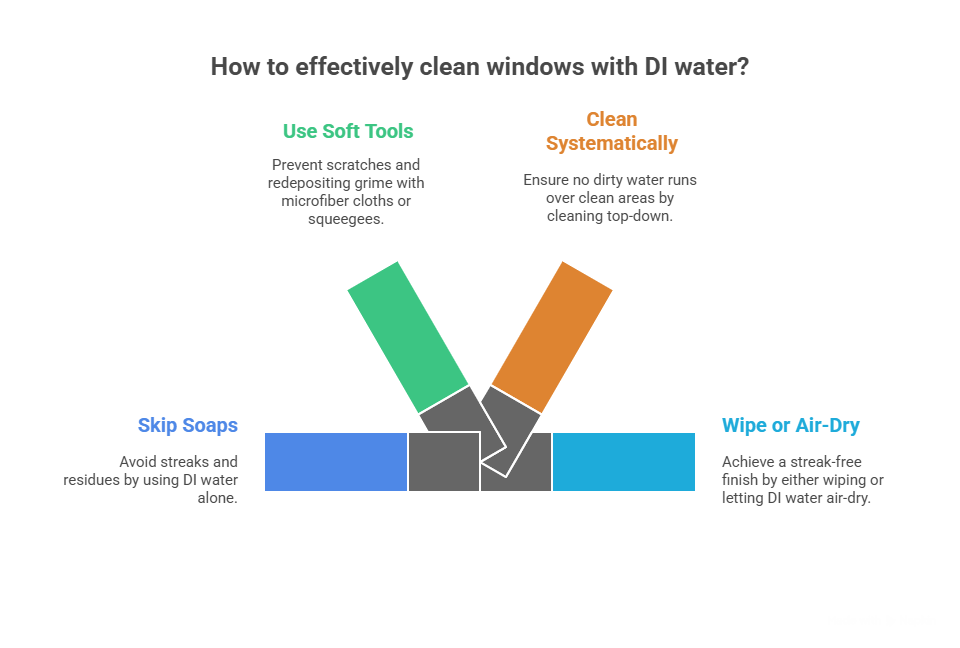
DI water makes cleaning easier, but a few best practices will optimize results:
- Skip soaps and detergents: Since DI water itself is so pure, you usually don’t need any cleaning chemicals. In fact, adding soap can leave streaks or residues. As Abacus recommends, “avoid using detergents or soaps… simply use the deionized water and a microfiber cloth”. The DI water alone dissolves and carries away dirt effectively.
- Use soft, clean tools: Microfiber cloths or a pure-water squeegee are ideal. They pick up any loosened dirt without scratching. Wring out and rinse cloths often in fresh DI water to avoid redepositing grime.
- Top-down, left-right: Clean windows systematically (for example, top to bottom). Dirty water should drip off the bottom, not run back over clean areas.
- Wipe or air-dry: One advantage of DI water is that it dries clear. You can simply let the water dry on its own for a streak-free finish. If you prefer to wipe, use the cloth or squeegee to remove excess water. Either way, you won’t see any spots left behind because DI water leaves no minerals to dry on the glass.
By combining DI water with gentle techniques, you’ll notice windows stay cleaner much longer and require less elbow grease.
Are there alternative methods if I don’t have a DI system?
If you can’t set up a full DI filter, there are a few workarounds:
- Distilled water: Store-bought distilled water is essentially water that has been boiled and condensed, leaving most minerals behind. It’s not perfectly ion-free, but it’s much purer than tap water. You can use distilled water from the store to rinse windows for better results. (Abacus even suggests using distilled water if your tap is very hard.)
- Rainwater: If you collect clean rainwater in a covered barrel, it’s usually low in minerals. You could use this as a rinse liquid, although it’s best used soon after collection.
- Water softener output: Water softeners swap hardness ions for sodium, so softened water will behave similarly to DI water (though it adds a bit of sodium residue). It’s better than hard water for cleaning, but may leave very faint smudges on glass.
- One-pass filters: Simple faucet filters (like carbon filters or pitcher filters) will remove chlorine and some particles, but they do not fully deionize. They’re a mild improvement for cleaning but won’t match true DI.
These alternatives can improve over plain tap water, but for truly spotless results, a dedicated DI or RO/DI system is the gold standard.
FAQs
Is deionized water the same as distilled water?
Not exactly. Distilled water is made by boiling water and condensing the steam, removing most minerals. Deionized water is filtered through ion-exchange resins to strip out mineral ions. Both are very pure, but DI water is usually a bit cleaner electrically (lower TDS) because it also exchanges trace ions. For window cleaning, either can work, though DI filtration tends to achieve higher purity for a streak-free shine.
What TDS reading indicates pure DI water for windows?
A TDS meter reading below 10 ppm is generally considered acceptable for window cleaning. Many pros aim for near 0 ppm (truly ultrapure water). If your meter shows higher than 10, it’s best to pass the water through the DI filter again.
How often should the DI resin or filter be replaced?
Replace or regenerate the resin whenever you see the water’s TDS creeping up. In practice, that often means swapping out DI cartridges after each big cleaning job or when performance drops. A safe rule is: change it as soon as the water stops being spot-free. Abacus recommends regularly monitoring and replacing the resin to keep water ultra-pure.
Can I reuse DI water that drips off the windows?
No. Once DI water flows over dirty glass, it picks up grime and minerals from the surface. That runoff is no longer pure and should be discarded. Always use fresh DI water for cleaning; reusing dirty rinse water defeats the whole point of deionization.
Should I let DI water dry on the glass or wipe it off?
The great thing about DI water is that it dries completely clear and dry on its own. You can simply let it air-dry, and you won’t see any spots. If you prefer, you can use a squeegee or a microfiber cloth to wipe it off, but it isn’t necessary to remove streaks. In either case, DI water will not leave mineral residue as regular water does.
Conclusion
Making your own deionized water unlocks the secret to streak-free windows. In this article, we’ve shown you the what and why of DI water, the gear needed (from simple hose-mounted filters to RO/DI systems), and step-by-step methods for producing ultra-pure rinse water. If you’d prefer to save time and get professional results, explore our window cleaning services for a spotless finish without the hassle. Remember to test your water with a TDS meter, replace resin regularly, and use clean tools for best results. With these techniques, even hard tap water won’t stand between you and crystal-clear glass. Now it’s time to give it a try – your windows (and your neighbors) will thank you for that perfect, spot-free shine!